
Last year, major tea companies performed well on the back of higher prices. However, a drop in prices over the past month and a half, is threatening to put a spanner in a repeat performance. Tea prices started on a strong note this year with prices ruling higher than last year on the back of crop loss due to adverse weather conditions. After mid-June, however, prices started dropping, though they are still higher than 2019-levels for north Indian teas (which account for more than 80 per cent of total production).

The facility, which will manufacture nicotine and nicotine salts, will conform to stringent US and EU pharmacopoeia standards that define purity levels at 99.2 per cent for nicotine meant for pharmaceutical products. ITC will leverage the institutional capabilities of its century-old leaf tobacco business for this. ITC's cigarettes business saw disruptions across the value chain with the onset of the Covid-19 pandemic. The company mentioned in its annual report that with easing of restrictions and improvement in mobility from September 2020 onwards, the business recovered progressively over the remainder of the year to reach nearly pre-Covid levels towards the close of the year.

With the threat of a third Covid-19 wave looming large, companies are scrambling to protect employees and keep operations safe--from a no-jab-no-entry-at-workplace policy to ramping up vaccination, it's an all-out effort to prevent the scale of devastation seen in the first two waves. At least two top steel companies--Tata Steel and ArcelorMittal Nippon Steel India (AM/NS India)--are pushing for vaccination certificates for entry into work premises. AM/NS India, a joint venture between world's leading steelmaker, ArcelorMittal, and Japan's Nippon Steel, is set to make vaccination the certificate a requirement from July 1.

33-year-old Abhishek Banerjee has emerged as the most visible and significant leader in the party after his pishi (aunt), Mamata Banerjee reports Ishita Ayan Dutt.
Most of the changes have come about in the last four years and ITC is now reaping the dividends - standalone revenues from the non-cigarettes FMCG business have grown 40 per cent from FY17 to Rs 14,728.21 crore in FY21 and pre-tax profits 30 times to Rs 823.69 crore. The business accounted for 30.58 per cent of gross revenues and 4.85 per cent of pre-tax profits in FY21. "In the last four years, our margins in FMCG have gone up by 640 basis points (bps) and EBITDA margins have been moving up consistently. "We created levers that enabled a sustained growth trajectory," said ITC chairman and managing director Sanjiv Puri. Puri took charge as the chief executive officer in 2017; in 2018, he was redesignated managing director and effective May 2019, he became chairman.
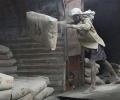
With the increased death rate in the ongoing second wave of Covid-19, domestic cement companies are in no better condition than they were in the April-June quarter of FY21 when the country faced nationwide lockdown. "This wave has had high death rate which has impacted the business. "We are in no better situation than last (year) April. "Deaths of drivers, dealers, contractors and also employees have hit the industry really very hard since April (FY22)," M Ravinder Reddy, director of Bharathi Cements said.

Scanty rainfall, last year's lockdown, growing competition from Nepal and the disaster of the 2017 Gorkhaland agitation are steadily weakening exports and sales of Darjeeling tea.

Those who know Alapan Bandyopadhyay describe him as measured, tactical and extremely focused on achieving what he sets out to do. To many it came as a surprise that he would cut short a meeting with the prime minister.

'Everyone wants to take a vaccine. The last time a camp was held, there were 1,000 people for 500 doses. People are waiting and returning disappointed. At times, it is creating problems. The demand is much more than the supply.' Ishita Ayan Dutt reports on how the West Bengal countryside is reacting to the vaccination drive.

The trade to-and-from India so far is not affected. But if the situation continues to remain the same for the next two to three months, it could definitely hurt India trade, including essential cargo.

Since April, India has seen multiple strains of the coronanavirus sweep the nation, upending life and businesses alike. Out-of-home retail and discretionary categories such as durables, auto, fashion, lifestyle, hospitality, food services, travel, and tourism have been the worst-hit as Covid cases remain high, leaving state governments with no option but to curtail mobility and economic activity.

Meanwhile, with China switching its trading partners due to geo-political issues, increased trade with South Africa for bauxite and with the US for coal is also auguring well for vessels with tonne miles going up.

Overall, Tata Steel becomes the seventh non-financial firm, including four oil PSUs to report quarterly revenues of Rs 50,000 crore.

Though the mandate is seen largely an outcome of Banerjee's welfare schemes, she has promised to industrialise at a faster pace, or so read the manifesto.

'The last three phases, the Trinamool gained more than expected due to Covid mismanagement by the Centre.'

UP Rs 50 billion, followed by Maharashtra, Bihar, and West Bengal which may need close to Rs 25 billion for the massive task.

With the government looking to divest loss-making steel assets, significant interest from secondary players is most likely this time apart from the anticipated list of large integrated primary steel producers, said industry experts. Rashtriya Ispat Nigam Limited (RINL), Neelachal Ispat Nigam Ltd (NINL), NMDC Integrated Steel Plant (NISP)-Nagarnar, Ferro Scrap Nigam Ltd and three units of Steel Authority of India (SAIL) - Alloy Steels Plant, Durgapur; Visvesvaraya Iron and Steel Plant, Bhadravati; and Salem Steel Plant, Salem - constitute the divestment list. All the three units of SAIL have been loss-making for more than five years.

Over the weekend, many companies stepped in to ease the bottleneck in supply and transportation of oxygen, as demand ran high with the surge in cases.

India Ratings expects long products demand growth to be sharp, supported by a demand push from the government-led infrastructure investments in affordable housing, railways, rural electrification and road networks.
With the O2C business outlook on the mend, the Street is also looking forward to news on RIL's proposal to sell up to 20 per cent of the O2C business to a strategic investor like Saudi Aramco.
 © 2025 Rediff.com - Investor Information - Advertise with us - Disclaimer - Privacy Policy - Sitemap - Feedback - About us - Terms of use - Grievances